Huawei Tau Scaling Law V2 paper discusses many aspects that will help the firm develop the Kirin 2026 chipset without using advanced equipment, one such being the “hybrid bonding” process. The new design concept hints at better efficiency and bandwidth for upcoming Huawei mobile processors.
Tau Law explains how the hybrid-bonding packaging concept can boost the performance of the Huawei Kirin 2026 chipset. It enables the SoC to adopt a 3D stacking layer, leading to a significant breakthrough in smartphone chips.
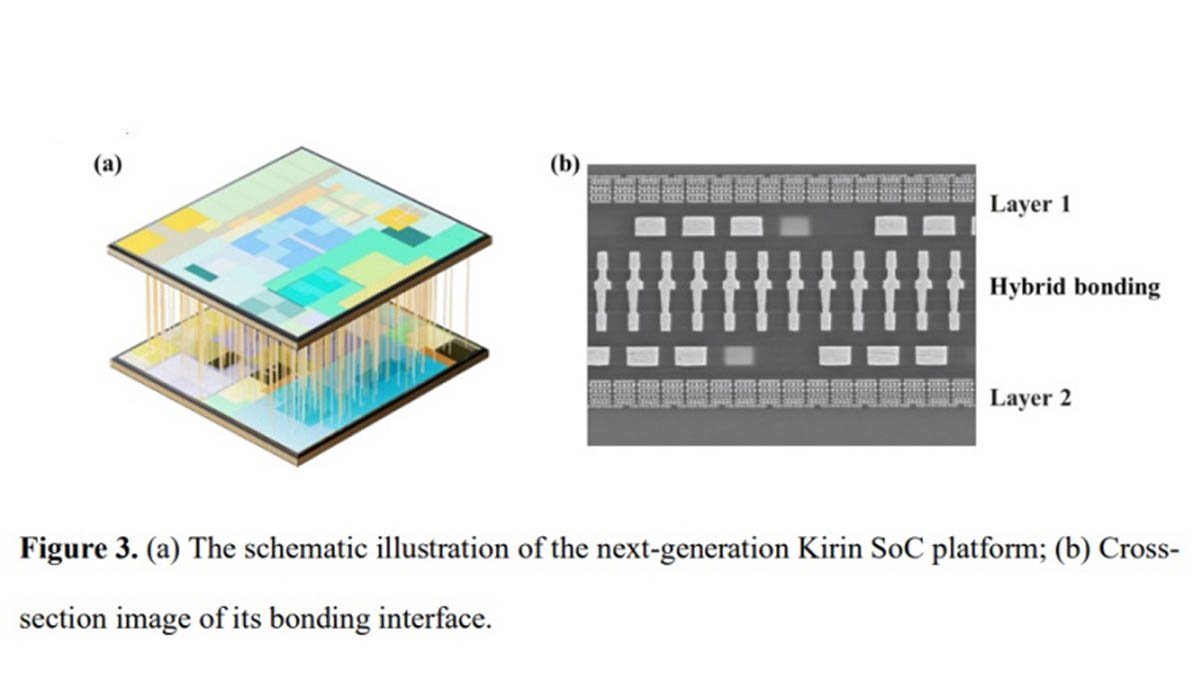
An illustration image shows how the Kirin 2026 processor will use the hybrid bonding method with dense vertical interconnecting points between layers.
It shows a concept of arranging several layers vertically on top of each other so data can travel micrometers instead of millimeters. This further ramps up communication speed between CPU, GPU, NPU, DRAM, and other components.

(Image Credits: Huawei)
Since the distance that signals and data travel is reduced, the chip requires less power to send electrical signals through long wires, boosting bandwidth.
Hybrid bonding is already an advanced semiconductor packaging technique. In many chipsets, the process uses direct copper-to-copper connections and dielectric bonding. This boosts interconnect density, reducing signal delay and power consumption.
On the flip side, it enables high-performance computing and compact HBM stacks. Simply put, the new approach not only uplifts the operational fluency of mobile chipsets but also increases efficiency.
Due to the US sanctions, Huawei was prohibited from using advanced chip-making technology. But over the years, the company has explored various tech solutions that can make its chip suitable in many aspects.
The company will launch the Kirin 2026 chip with the Mate 90 series phones this fall. In the meantime, it may reveal what other benefits the new mobile SoCs will bring over the previous generation processors. You can check some differences below:
Huawei shows how Kirin 2026 chip can differ from Kirin 9030 Pro