Two years and a $250 million lawsuit later, Apple’s AI Siri revamp is on its way to your phones and laptops and even your mixed reality headset, if you happen to be one of like three people who actually uses the Apple Vision Pro. Apple revealed a slew of new information at Monday’s WWDC keynote about these long-awaited, AI-powered updates that can take advantage of the fact that our hardware is supposedly “built for Apple Intelligence.”
To be honest, it’s hard for AI to impress me enough that I’ll use it in my day-to-day life. I still don’t trust LLMs to provide consistently accurate information, I find it ethically untenable (and uncool) to use AI to help me write, and I don’t feel the insatiable urge to know what I would look like as a Studio Ghibli character. But every once in a while, the promise of AI tempts me.
That’s how I felt watching Apple’s Siri AI demos, which depict a world where your phone comes with an always-on, constantly-working assistant who knows everything about you and can help you keep track of all of the conversations happening on like twelve different apps on your phone at any given moment.
To paraphrase Katy Perry, it feels so wrong (what are the privacy implications?), but it also feels so right (I am so overwhelmed by my phone and am begging for help parsing it all).
I want Siri to be my own personal Emily from “The Devil Wears Prada” — a “second brain” that anticipates my needs before I even know what they are. I want Siri to read my texts and automatically make an event when a friend and I decide we’re going to meet up for dinner on Thursday. I want Siri to remind me when I’m walking past CVS that I have a prescription ready for pickup. If I forget to reply to an important work email, I want Siri to remind me that I didn’t write back yet.

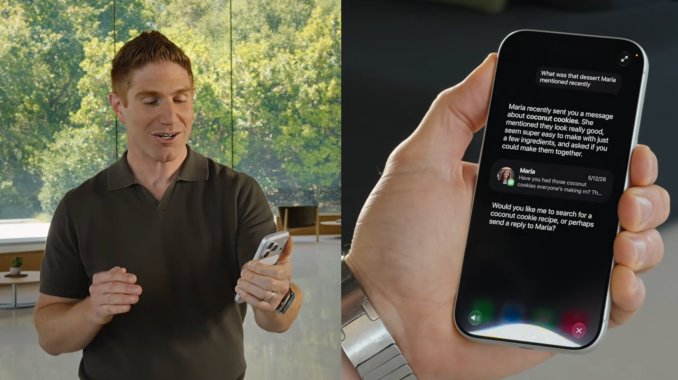
Siri AI won’t be able to do all of that out of the box, but it’s moving in the right direction. In one example at WWDC, Justin Titi, an Apple Senior Director working on AI engineering, asks the smart assistant to remind him of the dessert that his daughter mentioned recently. Siri searches across Titi’s phone to find a text from about a month ago, when his daughter mentioned that she wanted to make coconut cookies. It’s simple, but asking Siri to find that message saves time, rather than scrolling up through an entire month of conversation looking for that one specific text.
The new-and-improved Siri is designed to use “personal context,” which refers to any information you put into Apple-native apps, like iMessage, Notes, Calendar, Mail, Photos, and more. Siri will also be aware of what’s on your screen, so for example, if you scroll past a picture of a nice park on Instagram, you can ask it to find out where that park is. (We still don’t know if Siri will be able to integrate into non-native Apple apps; it seems like it might be up to the developers to make that happen.)
There already are apps like Poppy and Poke that try to create this kind of mobile, agentic AI. But the paradox of these AI personal assistant tools is that you have to give up a lot of personal data and privacy to make them work correctly, which may just cause you more trouble (remember that time when a Meta researcher ran OpenClaw and accidentally deleted her entire inbox?).

I can’t say that I love giving any tech giant my personal data, but Apple at least seems to care more about security than the other FAANG (MANGO?) companies. On-device AI will always be more secure and less energy intensive than cloud computing, since the data is processed directly on your phone. (This is how current Apple Intelligence features like email summaries and AI emojis are generated.) But for the more complex tasks that Siri will confront, Apple pioneered private cloud compute (PCC), a way for devices to parse complex data over the cloud without even exposing your data to Apple itself. (If it’s possible to hack PCC, it hasn’t happened yet, even though Apple offers a $1 million bug bounty.)
In a recent conversation with the writer Calvin Kasulke — who is so internet-brained that he wrote a novel that takes place exclusively on Slack — I confessed what feels like a taboo desire to outsource all of my “life admin” to an AI.
“When you talk about the nonsense of the tech detritus in your life… I think the question is, ‘Is all that you have necessary?’ If it is necessary, isn’t it worth cultivating the skill and spending the time to do it?” Calvin told me. “I don’t think that those are skills that one should allow to atrophy.”
He makes a good point: maybe instead of asking Siri to remind me about the TV show that my friend told me I should watch, I could pay more attention when I’m talking to my friends. I don’t want to get into the habit of forgetting more consequential details from my conversations.
“I’m sorry, but all of the commercials that are like, ‘What if I had the computer buy my kid a birthday gift?’ I’m like, ‘What if you learned what your kid likes?’ … Like, I don’t know man, it sounds like [they] don’t want to do the fundamental act of being a person,” he said.
Maybe when I say I want Siri to be like Emily from “The Devil Wears Prada,” I should remember that Emily’s character is on the verge of a crash out. I know I can’t psychologically impact Siri like Miranda Priestly damaged Emily, but will I become the kind of person who can’t function without the friendly robot voice in my phone? Do I want to be that person?
At least if I decide to opt out from all of this, Apple will make that possible. Unlike Google’s controversial Search overhaul, the new AI Siri can be toggled on and off, so you don’t have to use it. Until then, I’ll have to decide if it’s worth it to taste the forbidden fruit of Siri AI.
When you purchase through links in our articles, we may earn a small commission. This doesn’t affect our editorial independence.