Samsung’s Galaxy S26 Ultra will introduce a smarter cutting-edge feature this time called “Privacy Display,” and while exploring this new addition, it seemed that Huawei and Honor phones should also have this useful security technology.
As the Galaxy S26 series is approaching its launch time, more leaks are revealing information about the lineup’s upgrades. Besides hardware and software, something that’s catching everyone’s attention is the Samsung Privacy Display feature.
It’s a really advanced feature. While several devices rely on the software segment to safeguard their data and privacy, Samsung has used a new approach – hardware-level tech!
Sahil Karoul on X has shared a hands-on video of Samsung’s Galaxy S26 Ultra, which shows its most-buzzed-about Privacy Display feature. Just like Huawei’s anti-peeping feature, the new tool shields your privacy when in a crowded place.
However, there’s a twist!
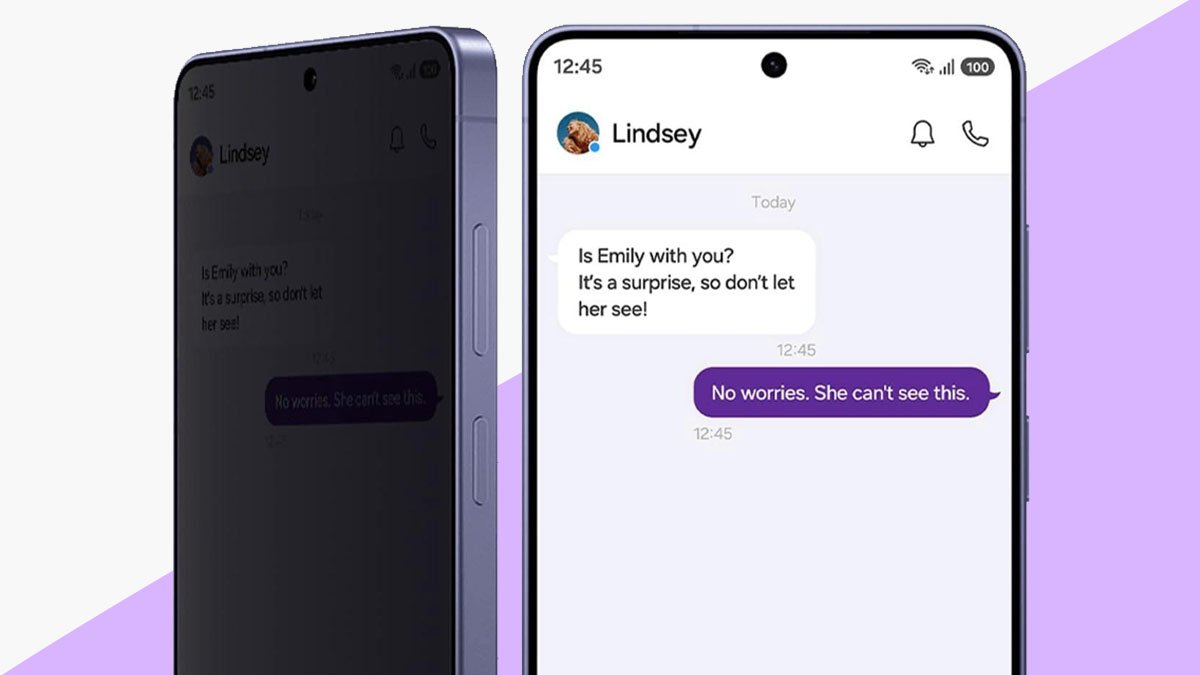
The hands-on video reveals that enabling the Privacy Display changes the visibility of the screen when viewed from an angle. In particular, one who is sitting beside you won’t be able to read the on-screen details or any confidential content.
As noted by Ice Universe, Samsung has used a dual-part optical control structure and embedded it directly in the display panel. Here, the first layer acts as a microscopic shade system. It is beneath the display panel.

(Image Credits: Weibo)
How does Privacy Display technology work?
Usually, the OLED light scatters in all directions under normal use. But in the Privacy Display mode, the liquid crystal layer instantly changes the state, causing a sudden shift in its refractive index. This shift results in activating an etched microscopic diffraction within the refractive layer.
In simple words, the OLED light that is scattered in all directions is now forced to diffract, obstructing its natural path and limiting side visibility.
On the flip side, the second layer is an optical refractive ramp filled with a prism. Now, the light already redirected by the first layer runs into the second layer (an optical barrier).
Here, wide-angle light rays turned off-axis are either distorted or just reflected into the screen due to refractive index differences. As a result, it prevents them from exiting toward those who are sitting by your side, making the display look blank.

(Image Credits: IceUniverse/X)
Huawei’s anti-peeping vs Samsung’s Privacy Display:
While Huawei’s AI technology solely relies on software, Samsung has now introduced a hardware-level privacy control that doesn’t need any filter or dimming light process.
Moreover, Privacy Display has two modes: Standard and Maximum. The first is a simpler one. But in case you are looking for a stronger anti-peeping feature, then you can switch to the Maximum Privacy Protection.
Apart from software strength, Huawei and Honor should have this more robust privacy feature. It not only hides your confidential content but also offers relief which lacks in Huawei devices that didn’t receive the AI anti-peeping feature.
The post Huawei and Honor should have Samsung’s Privacy Display feature appeared first on Huawei Central.