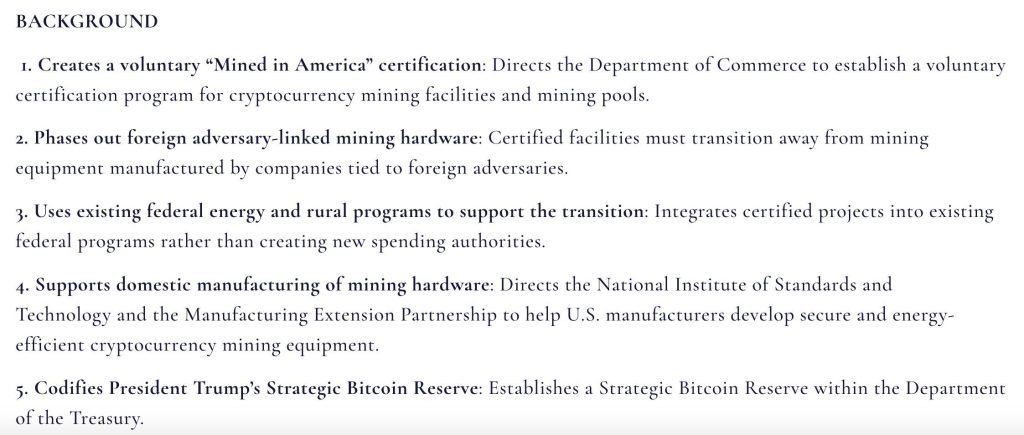
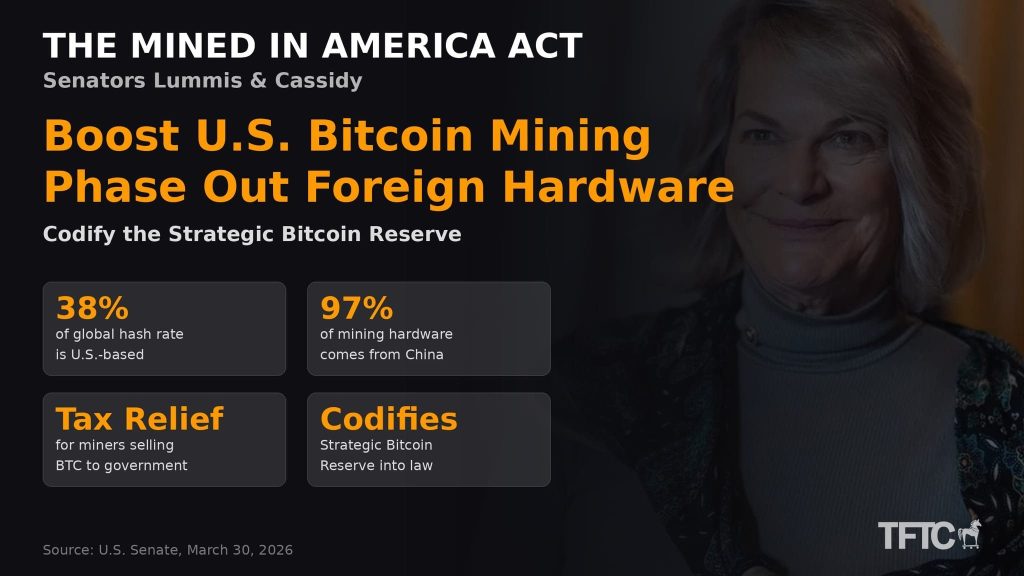
Senators Bill Cassidy (R-LA) and Cynthia Lummis (R-WY) introduced the Mined in America Act on March 30, creating a federal certification program for domestic Bitcoin mining operations and codifying President Trump’s Strategic Bitcoin Reserve executive order into law.
The bill targets a structural vulnerability that the industry can no longer ignore: the U.S. controls 38% of global Bitcoin hash rate but sources 97% of its mining hardware from China.
That asymmetry is the entire legislative thesis. Hash rate geography and hardware dependency are two different things – and right now, they’re pointed in opposite directions.
Key Takeaways:
- Legislative Scope: The Mined in America Act creates a voluntary Commerce Department certification for mining facilities that commit to phasing out hardware from foreign adversaries, with full transition required by end of decade.
- Federal Access: Certified miners unlock existing DOE and USDA programs for grid stabilization, renewable absorption, and methane capture – no new federal spending required.
- Reserve Pipeline: The bill codifies Trump’s Strategic Bitcoin Reserve and creates a mechanism for certified U.S. miners to sell newly mined BTC directly to the reserve in exchange for capital gains tax exemptions.
- Hardware Vulnerability: Late 2024 customs inspections found firmware vulnerabilities in Chinese mining rigs enabling potential remote access – the security case underpinning the bill’s hardware phase-out mandate.
- What to Watch: Committee assignment to Senate Commerce or Energy and Natural Resources – that referral determines hearing timeline and amendment exposure for the incentive structure.
What the Mined in America Act Actually Does – and Why the Certification Structure Matters
The bill’s core mechanism is a voluntary certification program administered by the Commerce Department. Mining entities that opt in commit to a phased elimination of hardware manufactured by companies tied to foreign adversaries – China and Russia named explicitly – with full phase-out required by the end of the decade.
That distinction matters operationally. Voluntary means no penalty for non-participants, but the incentive architecture is designed to make certification economically attractive. Certified facilities gain access to existing Department of Energy and USDA rural financing programs – covering grid-stabilizing load, excess renewable absorption, and methane capture from landfills and oil fields.
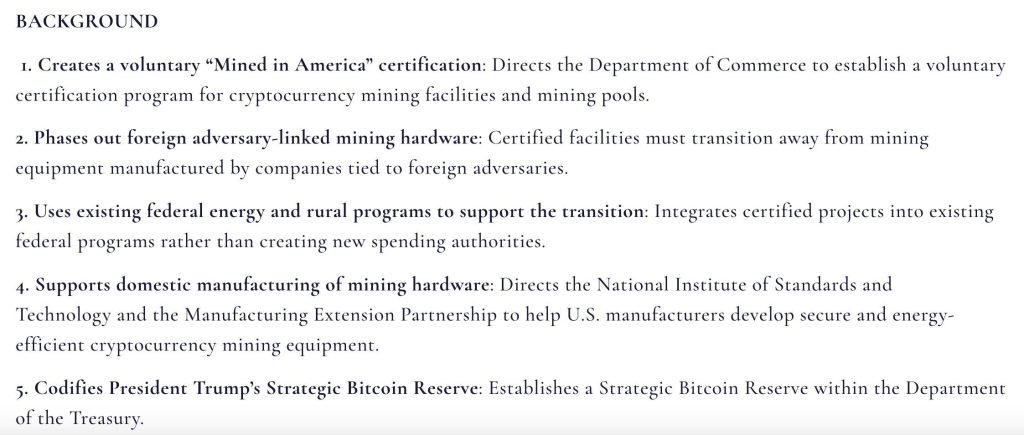
No new appropriations required, which is the bill’s primary political insulation against deficit hawks.
The National Institute of Standards and Technology and the Manufacturing Extension Partnership would be directed to support U.S. firms developing domestic ASIC miners, with domestic assembly mandates attached.
NIST’s role here is notable – it signals the bill frames hardware security as a standards problem, not just a trade policy problem.
The Strategic Bitcoin Reserve codification adds a direct supply-chain-to-reserve pipeline. Certified miners can sell newly mined BTC to the reserve in exchange for capital gains tax exemptions – a budget-neutral expansion mechanism that doesn’t require Treasury to go to market.
Dennis Porter, CEO and co-founder of the Satoshi Action Fund, which co-crafted the legislation, put it plainly: “America controls 38 percent of the world’s Bitcoin hash rate, but 97 percent of the hardware powering it comes from China. That is not leadership, that is a liability.”
Discover: How MicroStrategy’s Bitcoin strategy could shift under new US mining policy
What to Watch
The bill’s immediate gating variable is committee referral – Senate leadership will assign it to either the Commerce, Science, and Transportation Committee or the Energy and Natural Resources Committee, likely within weeks.
The Commerce referral is the faster path; Energy and Natural Resources has a heavier docket and more competing priorities in Q2 2026.
Watch for a companion House bill within 60 days – Lummis has coordinated House counterparts on prior crypto legislation and the political incentive to move in parallel is strong ahead of midterm positioning.
NIST’s initial ASIC development guidelines are also a near-term signal – if those drop within 90 days of potential passage, it indicates the executive branch is moving implementation infrastructure ahead of floor votes, which is typically a signal of White House prioritization.
For mining stocks, the first-mover indicator is DOE program eligibility guidance – if Commerce and DOE issue joint certification criteria quickly, expect MARA, RIOT, and CLSK to move on the news before any operational benefit materializes.
The bill is on the calendar. Whether the incentive structure survives committee markup intact – particularly the capital gains exemption for reserve sales – is the variable traders need to track.
Discover: The best Bitcoin investment strategies for the current macro environment
The post Senators Introduce ‘Mined in America’ Bill to Boost US Bitcoin Mining appeared first on Cryptonews.