The traditional crypto exchange experience is anything but simple. You need to create an account, then verify your email, and submit identity documents. Then wait for approval and set up two-factor authentication. Deposit funds. Withdraw to your wallet. The process can take days and goes on and on before you actually own the asset you wanted.
For many users, this process can be completely unnecessary. Not everyone wants to trade on margin or place limit orders. Some just want to swap one cryptocurrency for another; quickly, privately, and without the overhead of creating yet another online account.
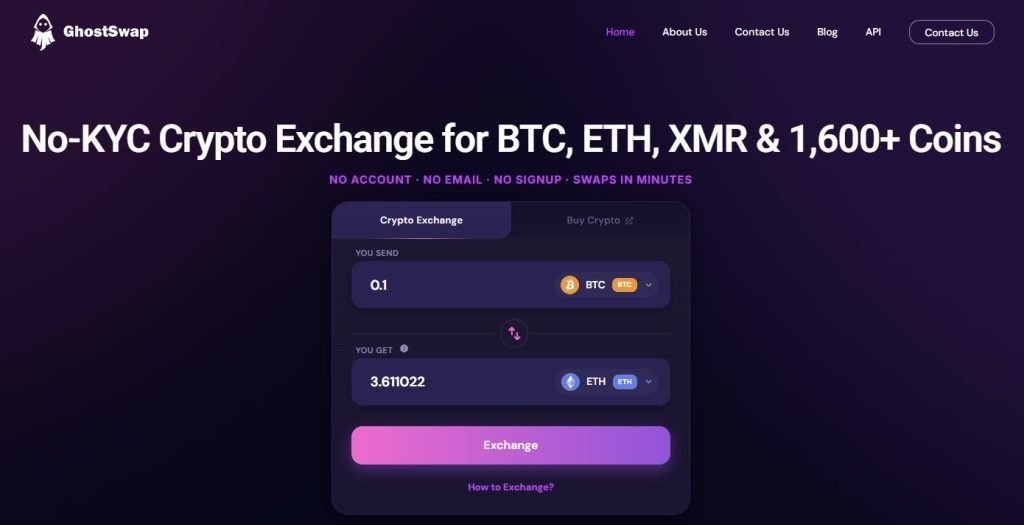
GhostSwap offers exactly that. It’s a non-custodial “instant swap” platform that lets users exchange cryptos without creating an account or providing personal information.
The process actually can’t be more simple: choose a pair, enter a destination address, send the source coin to a one-time deposit address, and receive the new coin, typically within minutes. No email, and no KYC. Just a swap.
What Is GhostSwap?
GhostSwap is a non-custodial swap aggregator that connects user transactions across multiple liquidity sources to find the best available rate. GhostSwap never takes long-term control of user assets, unlike centralized exchanges. Funds move directly from the user’s wallet through the swap process and land in the destination wallet.
GhostSwap supports over 1,600 tokens across major blockchains, including Bitcoin, Ethereum, Solana, Polygon, and (maybe most importantly) privacy-focused assets like Monero (XMR) and Zcash (ZEC). This deep support for privacy coins sets GhostSwap apart from many competitors that have delisted these assets due to regulatory pressure.
Key features, or let’s say, unique selling points, include:
- No signup, no email, no KYC for standard swaps
- 1,600+ supported assets across multiple chains
- Telegram bot for swaps without leaving the messaging app
- Public API for developers and business integrations
- Flat 2% fee quoted upfront, included in the exchange rate
GhostSwap has processed over $750 million in swaps for around 1.5 million users. The company is registered as a Delaware LLC and operates as an anonymous crypto exchange that prioritizes user privacy and simplicity.
How GhostSwap Works
The user experience is intentionally minimal. Here’s what actually happens during a swap:
Step 1: Choose the Coins You Want to Swap
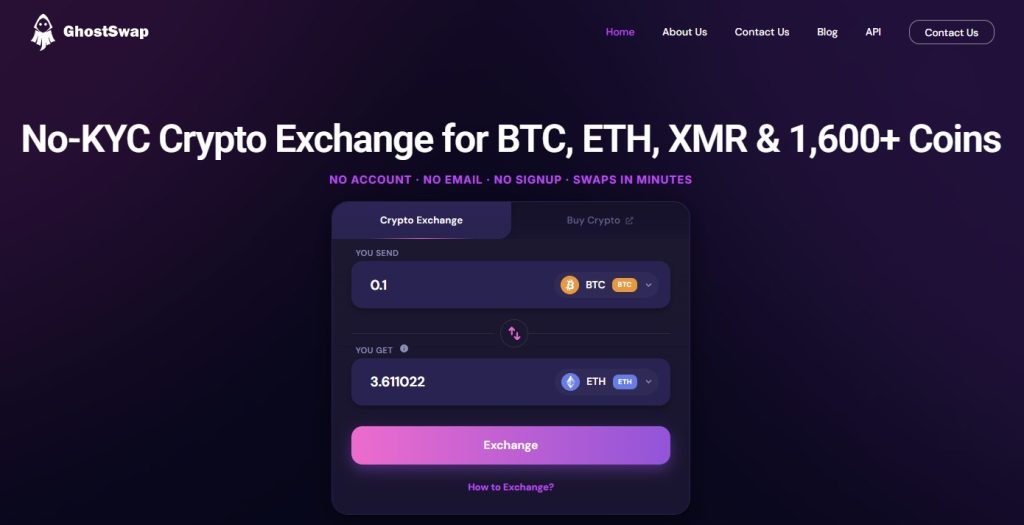
Users begin by selecting a coin to send and a coin to receive from drop-down menus. The interface supports cross-chain swaps, for example, Bitcoin to Solana or Ethereum to Monero. The source and destination assets can be on completely different blockchains; GhostSwap handles the bridge behind the scenes.
Step 2: Enter a Destination Wallet Address
The only information GhostSwap requires is a receiving wallet address for the output coin. There’s no account creation, no email verification, and no identity documents. Just paste the address where you want your funds to land.
Step 3: Send Your Crypto
Once the user confirms the swap details, GhostSwap generates a unique one-time deposit address. The user sends their source coin to this address directly from their own wallet. The address is temporary and tied exclusively to that specific transaction.
Step 4: Receive the New Asset
After the blockchain confirms the deposit, GhostSwap’s backend automatically executes the swap across its liquidity sources and sends the output coin to the user’s provided destination address. The entire process is on-chain and non-custodial.
Step 5: Verify the Transaction
Users can track their swap’s progress through GhostSwap’s status page or, if using the Telegram bot, through real-time updates in the chat. Once the transaction is complete, the funds are in the user’s wallet; no further action required.
Typical completion times range from a couple of minutes for fast chains like Solana or Polygon to about 30 minutes for slower chains like Bitcoin, depending on network congestion. GhostSwap warns users to have a bit of the chain’s native gas token (e.g., ETH) in their sending wallet to cover network fees.
The User Experience: What Makes GhostSwap Different?
Compare the GhostSwap workflow to a traditional exchange:
Traditional Exchange:
- Create account
- Verify email
- Complete KYC (submit ID, wait for approval)
- Set up 2FA
- Navigate to trading pair
- Place order
- Wait for execution
- Withdraw to wallet
GhostSwap:
- Select pair
- Enter destination address
- Send funds
- Receive coins
That’s it. Four steps instead of eight or more. No password management, no identity verification, no account recovery processes to remember. Fewer steps between intent and execution means less friction and a faster experience.
Supported Coins, Networks, and Privacy Assets
GhostSwap supports over 1,600 coins and tokens across numerous blockchains. The platform’s official documentation promotes cross-chain swaps, for example, Bitcoin to Solana or Ethereum to Polkadot, and specifically lists privacy coins like Monero (XMR) and Zcash (ZEC) among supported assets.
Monero (XMR) support: GhostSwap includes XMR as both a send and receive option. Pairs like BTC to XMR and ETH to XMR are listed among the platform’s top offerings. For users who value financial privacy, this is a pretty big advantage; Monero is the leading privacy coin, and its availability on GhostSwap means users can move in and out of it without creating a paper trail on a centralized exchange.
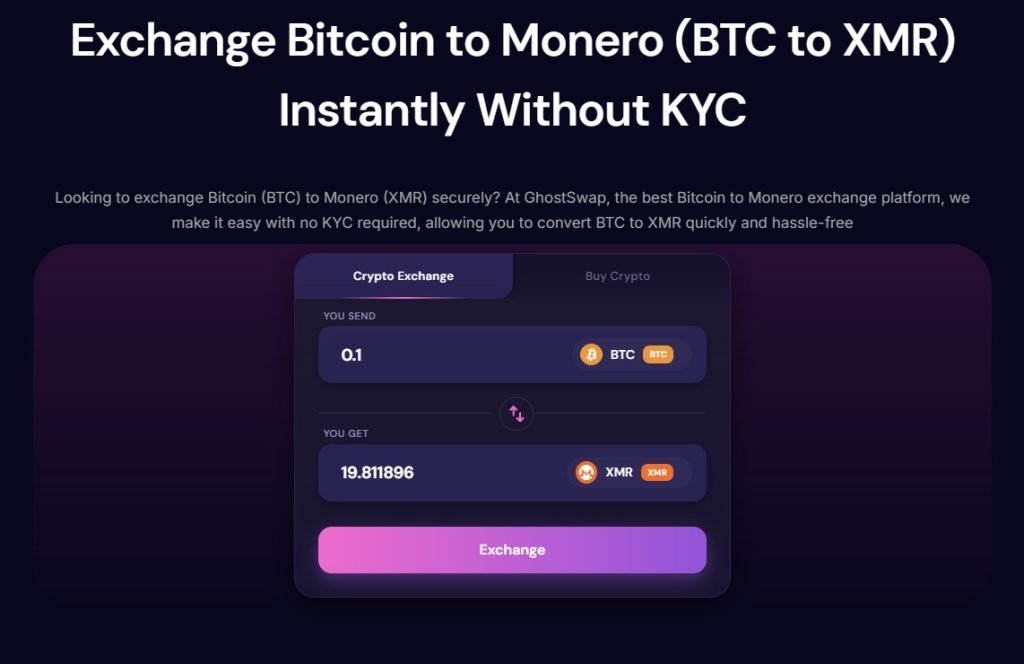
Zcash (ZEC) support: Similarly, Zcash appears in GhostSwap’s supported pairs list (BTC to ZEC, ETH to ZEC, USDT to ZEC, etc.) on the platform’s “All pairs” page. Zcash offers shielded transactions that hide sender, receiver, and amount; another option for privacy-conscious users.
The platform aggregates liquidity from multiple providers, so depth varies by coin. No official liquidity numbers are published, but GhostSwap claims to find “the best rates across multiple liquidity providers.” For smaller swap sizes (e.g., under several BTC worth), adequate liquidity should be available.
Privacy coins may be more thinly traded on global markets than majors like BTC or ETH, but GhostSwap’s aggregator model helps source liquidity where it exists.
GhostSwap’s Fee Structure
GhostSwap charges a flat 2.0% baseline fee (spread) on every swap, built directly into the quoted rate. Users see this fee upfront as part of the exchange rate and the final receive amount. For example, on a $10,000 swap, the implied cost is roughly $200, plus normal on-chain gas fees.
How the Fee Is Quoted Upfront
When a user selects a pair and enters an amount, the interface immediately shows the estimated output amount and the total fee. GhostSwap explicitly highlights that all fees are “included directly in the exchange rate displayed” before confirmation; no hidden charges appear at checkout.
Are There Additional Costs?
Standard blockchain network fees (miner/gas fees) are extra and come from the user’s wallet. These are not GhostSwap fees but rather costs inherent to sending any on-chain transaction. Additionally, if the market moves dramatically before the deposit confirms, extreme cases of slippage could occur; though GhostSwap does re-quote if confirmations take a long time.
Comparing Fixed-Fee Simplicity to Exchange Pricing
GhostSwap’s 2% fee is higher than some competitors. Changelly advertises fees around 0.25%, Godex charges approximately 0.5%, and FixedFloat offers 1% for fixed-rate and 0.5% for floating-rate swaps.
However, these platforms may not support the same range of privacy coins, may require accounts for certain features, or may have less transparent fee structures. GhostSwap’s simplicity (one flat rate, no tiers, no surprise charges) is good for users who want to know exactly what they’re paying before they commit.
Is GhostSwap Legit?
This is arguably the most important question for any user considering a new crypto platform.
What “Legit” Means in Crypto Swapping
In the context of instant swaps, legitimacy doesn’t mean guaranteed safety or regulatory approval. It means the platform delivers what it promises (fast, private, on-chain swaps) without scamming users or failing to execute transactions.
Signs That Users Commonly Look For
GhostSwap provides a public website and extensive documentation, a transparent swap process, a published API, a functional Telegram bot, and user-facing support channels. The platform has been operational for years and has processed over $750 million in swaps for approximately 1.5 million users.
Independent reviews and user reports generally confirm that swaps execute as advertised.
The Non-Custodial Element
GhostSwap is strictly non-custodial. It never takes long-term custody of user funds. Instead, each swap goes through a temporary deposit address: the user’s coins are sent from their wallet to this address, and immediately upon confirmation, GhostSwap releases the new coins from an upstream liquidity source into the user’s receiving wallet.
No pooled account is ever held on GhostSwap. This avoids many hacking risks associated with centralized exchanges, where large pools of customer funds become attractive targets.
What GhostSwap Does and Doesn’t Promise
GhostSwap delivers fast, anonymous crypto swaps with minimal friction. It does not promise to be the cheapest option, to provide advanced trading features, or to offer regulatory protection in every jurisdiction. Users should treat it as an advanced tool (ideal for moving privacy coins or cross-chain trades) and use small test amounts until comfortable.
Privacy and KYC: How Does GhostSwap Handle Identity Verification?
A core GhostSwap promise is no KYC. The site and terms repeatedly state that users need provide only a destination address; no name, ID, email, or phone. GhostSwap is an anonymous crypto exchange in the sense that it doesn’t collect identity-linked data from users. As one Binance.com guide puts it, GhostSwap has “zero registration, no identity documents.”
However, “no KYC” does not mean no compliance. GhostSwap is a Delaware-registered LLC and explicitly works with licensed crypto processing partners to handle AML/sanctions screening. In practice, each transaction is shared with these partners for automated checks. If a swap is flagged (e.g., for high value or hitting a blacklist), GhostSwap reserves the right to block, reject, or refund it.
The terms of use warn users that transactions may be subject to AML/KYC compliance “by licensed third parties.”
Information Users Are Not Required to Provide
Information needed to trade on GhostSwap is really simple; no email, no name, no address, no ID documents, no phone number. Users can even access GhostSwap via Tor or VPN without issue, which further enhances privacy.
Situations Where Compliance Obligations Could Arise
If a transaction is flagged by automated systems (often due to large size, unusual patterns, or connections to known suspicious addresses) GhostSwap may delay, block, or refund the swap. In some cases, third-party compliance partners may request additional information. This is relatively rare for standard swaps but is explicitly covered in GhostSwap’s terms.
Security Considerations Before Using Any Instant Swap Service
Even though GhostSwap’s non-custodial design eliminates many hacking risks, users should be aware of the risks that remain:
Verify Wallet Addresses Carefully
Once a transaction is sent to a blockchain address, it cannot be reversed. Mistyping a destination address or selecting the wrong network can result in permanent loss of funds. Always double-check addresses before confirming a transaction.
Double-Check Network Compatibility
Sending a coin to an address on the wrong network (e.g., sending BSC tokens to an Ethereum address) can result in loss. GhostSwap provides warnings, but the final responsibility lies with the user.
Start With a Small Test Transaction
Before swapping a large amount, send a small test transaction to verify that the address is correct, the network is compatible, and the swap executes as expected. This is standard practice in crypto and costs little in fees.
Understand Blockchain Confirmation Delays
Swap completion times depend on network confirmations. Bitcoin transactions can take 10–30 minutes; faster chains like Solana complete in seconds. If a transaction is delayed, it’s usually due to network congestion rather than a platform issue.
Keep Control of Your Private Keys
GhostSwap never asks for private keys. If any platform requests your private keys, it’s a scam. GhostSwap’s non-custodial design means the user remains in control of their funds throughout the process.
Beyond the Website: Telegram Bot and Public API
Using GhostSwap Through Telegram
Launched in 2025, the @GhostSwapBot on Telegram allows swaps without a browser. The bot mirrors the web UI: users start a chat, select coins, enter an amount, paste a destination address, and get a deposit address from the bot.
Real-time updates are shown as the swap proceeds. This integration allows users to swap without even leaving Telegram; a standout feature few swap platforms offer.
The Public API
GhostSwap exposes a server-to-server API for business integrations (wallets, apps). GhostSwap’s API is authenticated by bearer tokens. Key endpoints include:
- /v1/quotes (get price quote)
- /v1/addresses/validate (validate a payout address)
- /v1/swaps (create a swap)
The docs stress idempotency (retry safety) and real-time status polling. Rate limits are generous: up to 120 requests per second per IP and 30 requests per second per API key. Partners can quickly integrate swaps into apps with high throughput.
Why These Tools Matter
The Telegram bot and API expand GhostSwap beyond a standard web interface. Users can swap from anywhere – even from a messaging app – and developers can integrate GhostSwap’s swap functionality into their own applications, wallets, and services.
Who Is GhostSwap Best Suited For?
GhostSwap serves several distinct user profiles:
Privacy-Conscious Users
People who value financial privacy and don’t want their transactions linked to their identity. GhostSwap’s no-KYC model and support for privacy coins like Monero and Zcash make it an attractive option.
Users Making Occasional Swaps
For users who swap crypto infrequently – perhaps a few times a year – creating accounts on multiple exchanges is overkill. GhostSwap’s pay-as-you-go model is ideal for occasional needs.
People Who Want to Avoid Exchange Onboarding
Account creation, email verification, KYC, and 2FA setup can take days. GhostSwap eliminates all of this.
Developers and Service Operators Using the API
Businesses and developers integrating crypto swaps into their applications can use GhostSwap’s API to add swap functionality without building their own liquidity infrastructure.
Users Swapping Into or Out of XMR and ZEC
GhostSwap maintains support for privacy coins that many exchanges have delisted. For users who need to move into or out of Monero or Zcash, GhostSwap provides a reliable option.
Potential Drawbacks and Limitations
GhostSwap is not for everyone. Several limitations are worth noting:
- No advanced trading features: GhostSwap is designed for simple swaps, not trading. There are no order books, charting tools, limit orders, or margin trading.
- Not a full exchange account: Users cannot hold balances on GhostSwap or repeatedly trade without paying the 2% fee each time. It’s a swap service, not an exchange account.
- No order books: Prices are set by GhostSwap’s aggregator engine, not by user orders. Users cannot set their own prices or wait for specific market conditions.
- Dependence on blockchain conditions: Swap speed depends entirely on the underlying blockchain. Users cannot accelerate their swap beyond the chain’s confirmation requirements.
- Fees may not always be cheapest compared to active trading platforms: The 2% flat fee is higher than what a user might pay on an exchange with lower trading fees. For very large or frequent swaps, an exchange account might be more cost-effective.
- Regulatory ambiguity: GhostSwap operates in a regulatory gray zone. No formal licenses or public audits are mentioned. Users in jurisdictions with strict crypto laws should consider the legal implications of using an anonymous crypto exchange.
- Potential for flagged transactions: While GhostSwap itself doesn’t require KYC, its compliance partners may flag and block certain transactions, especially large ones.
Frequently Asked Questions
Do I Need an Account to Use GhostSwap?
No. GhostSwap requires no account, no email, and no password. Users simply select a pair, enter a destination address, and send funds.
Does GhostSwap Require KYC?
No. GhostSwap does not require identity documents, name, address, or phone number for standard swaps. Compliance checks are handled behind the scenes by partners and may occasionally flag transactions.
How Long Do Swaps Take on GhostSwap?
Typical completion times range from a couple of minutes for fast chains (Solana, Polygon) to approximately 30 minutes for slower chains (Bitcoin). Most swaps complete within 5–30 minutes.
Which Coins Are Supported on GhostSwap?
GhostSwap supports over 1,600 coins and tokens across major blockchains, including Bitcoin, Ethereum, Solana, Polygon, Monero, Zcash, and stablecoins like USDT and USDC.
Does GhostSwap Support Monero?
Yes. Monero (XMR) is fully supported as both a send and receive option. Pairs like BTC to XMR and ETH to XMR are available.
What Is the GhostSwap Fee?
GhostSwap charges a flat 2% fee built into the quoted exchange rate. This is the total service fee; users also pay standard blockchain network fees (gas).
Can I Use GhostSwap Through Telegram?
Yes. The @GhostSwapBot on Telegram allows users to perform swaps directly within the messaging app. The bot mirrors the web interface and provides real-time updates.
Does GhostSwap Offer an API?
Yes. GhostSwap has a Partners API for business integrations with endpoints for quotes, address validation, and swap creation. Rate limits are generous (120 requests/sec per IP, 30 requests/sec per API key).
Is GhostSwap Custodial or Non-Custodial?
Non-custodial. GhostSwap never takes long-term custody of user funds. Each swap uses a temporary deposit address, and funds are routed directly to the user’s destination wallet.
What Happens if I Send the Wrong Asset?
Sending the wrong asset to a deposit address can result in permanent loss. GhostSwap’s terms explicitly state that users are responsible for sending the correct coin to the correct address. Always double-check before confirming a transaction.
Wrapping Up
All in all, GhostSwap delivers on its core promise: fast, private, non-custodial crypto swaps without the overhead of traditional exchange onboarding. It’s not the cheapest option, and it doesn’t offer advanced trading features, but for users who value simplicity and privacy, it’s a compelling choice.
The platform’s support for Monero and Zcash, along with its Telegram bot and public API, make it a versatile tool for both individual users and developers.
The post No Email, No Account, No KYC: How GhostSwap Swaps 1,600+ Coins in One Step appeared first on Cryptonews.