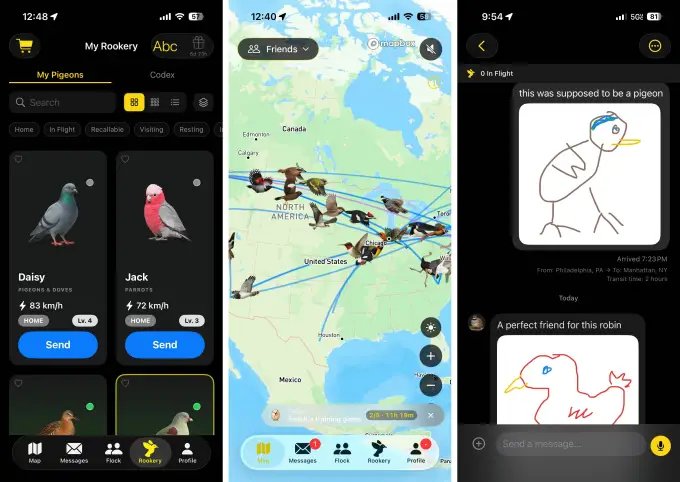
Somewhere above the Great Plains, a virtual woodpecker is on its way to Alaska to deliver a message to my anonymous pen pal. At the same time, a zebra finch named Tucker soars into Manhattan to send a friend my shabby doodle of the Cool S.
These messages take hours or even days to send, depending on how far the bird has to fly, as that’s the point of Roost, the viral “slow-cial” app that’s making carrier pigeons cool again. Roost arrives at a time when people crave the opportunity to slow down and disconnect from the apps that constantly demand their attention and are embracing technology that adds friction.
“Everything on a phone is instantaneous these days — every single thing you do, it’s like you’re always getting some notification or something,” Roost creator Logan Mendelsohn told TechCrunch. “[Roost] is kind of a break from the instant. It’s resonating with people in a way where they don’t feel pressure all the time to have to do something.”

When you sign up for Roost, you choose four birds to add to your rookery, which allows you to send messages to your friends on the app.
Each bird moves at the speed that it travels in real life, so a falcon will deliver a message much faster than a hummingbird. (Yes, not every bird is a carrier pigeon, but including other species makes collecting birds and seeing your friends’ birds more interesting.) If you really want to slow things down, you can send snails or turtles instead.
A senior product manager in trust and safety at Ticketmaster, Mendelsohn started building Roost as a fun side project to use with his friends, but they loved the app so much that they encouraged him to publish it to the App Store.
Mendelsohn’s friends were onto something. The app developed a very small niche following, but it started to grow exponentially when a mother posted on Threads about how her daughter was communicating with her friends in Elizabethan English on an app that sends messages at the speed of actual birds.

Within three days after that post, the app grew from 10,000 to 100,000 users. Now, about five weeks later, Roost is about to hit 300,000 users.
“The people are what really make this platform, and what people kept talking about is how wholesome it is, and how whimsical it is, and how much this really helps them put more intention into what they’re saying to people,” Mendelsohn said. “There’s a lot less pressure when you know that the message isn’t going to someone immediately that I think has really resonated with the user base.”
As a trust and safety professional by day, Mendelsohn knows that any social platform — even his innocent bird app — has the potential to be abused. So, by default, only a user’s city is shared with their friends. You can choose to manually enable a “close friends” feature to share your precise location with specific people, however.

“I personally think that for any new platform that connects people, trust and safety should be the first thing they think about,” Mendelsohn said. “When you’re able to start at zero with that lens, then you can build it into the platform instead of doing it later.”
Privacy concerns were also front of mind when Mendelsohn created the “Pen Pals” feature, which allows you to exchange messages with anonymous users in your age group. When onboarding onto the feature, you are explicitly warned not to give out your actual contact information or personal details. The app deliberately does not support photo sharing yet, as Mendelsohn wants to build out more sophisticated content moderation tools first.
Given the sheer size and scope of Roost — did we mention there are mini games? — it doesn’t come as a surprise that Mendelsohn has used Claude Code throughout its development. But the kind of people flocking to Roost tend to be people who are fatigued by the state of the tech industry, which drove them to seek out a “slow-cial media” app in the first place.
Soon, Mendelsohn started receiving an onslaught of complaints from people who were disappointed to learn that he used AI-generated art for the images of birds.
“On the AI art side, I completely understood the feedback. I won’t lie, it was daunting to see the reaction online, [but] I don’t think it’s productive to dig your heels in when your community is vocal about something they care for,” he said. “At the same time, I also knew I couldn’t flip a switch overnight. Replacing the art in an app this size takes time, planning, and money.”
Mendelsohn’s resources are limited as he continues to work on Roost in his spare time. He has no outside funding, and the app only generates revenue from in-app purchases like extra birds. To address users’ concerns about the use of AI, he’s now running a contest which will allow artists to contribute art instead. While that has satisfied complaints for now, the situation reflects a rising tension in the consumer app space. Many users now boycott AI art out of respect for artists, but the situation with Roost’s vibe-coded app shows the situation isn’t always cut-and-dried.
“As a solo founder, I don’t think I could build and maintain something at this scale without AI-assisted development, but every product decision and direction for Roost still comes from me and the community,” he said.
When you purchase through links in our articles, we may earn a small commission. This doesn’t affect our editorial independence.